


The Lost Story of Hassell Hall
How Three Forgotten Initials in a West Yorkshire Manor House Revealed an Extraordinary Historical Connection with Argentina
By Ezequiel Foster
Author's Note
Historical research rarely follows a straight path.
More often, it begins with a question so small that it seems almost insignificant—a name in a parish register, a forgotten property on an old map, or a weathered inscription whose meaning has long been lost.
This investigation began with three carved initials above the entrance to a forgotten seventeenth-century manor house in West Yorkshire.
What followed was an international documentary investigation based on parish registers, property deeds, probate records, historical maps, newspapers and official archives preserved in England and Argentina. Together, these sources reconstructed a historical narrative that had remained fragmented for more than three centuries.
Rather than presenting a family genealogy, this article demonstrates how documentary evidence can restore the identity of forgotten places, reconnect historical records long separated by time and distance, and reveal the shared heritage linking communities across generations and continents.
This investigation forms part of FOSTER History & Collective Memory, an international historical research initiative dedicated to reconstructing the documented history of people, families and places through the comparative study of original archival sources preserved in different countries.
"History reaches its greatest purpose when it uncovers the stories that, even across centuries, have quietly connected people and nations."
— Ezequiel Foster
Three Initials. One Forgotten Manor. A Mystery That Survived Three Centuries.
Another story had already begun.
It began in silence.
Not inside a palace.
Not within the halls of government.
Not on a battlefield.
But above the entrance to a manor house standing on the outskirts of Ossett, in what is now West Yorkshire.
There, sometime in 1699, three initials were carved into a stone lintel.
F.R.H.
Alongside them appeared a single date.
1699.
No names.
No explanation.
No inscription recording who those letters represented.
Only three carefully carved initials that would outlive the house itself.
For more than three hundred years, they remained unanswered.
An Unexpected Connection
Whenever England and Argentina meet on the football pitch, millions watch.
Newspapers analyse every tactical decision.
Supporters relive memories stretching back decades.
Commentators revisit moments that have become part of football folklore.
When the final whistle sounds, another result takes its place in sporting history.
Yet football is only one chapter in the long history shared by these two nations.
Long before either country played its first international match, another connection had already been quietly unfolding.
It was not preserved in stadiums.
Nor in trophies.
It survived instead within parish registers, property deeds, official records and forgotten archival collections.
For generations, almost nobody knew it existed.
Today, those surviving documents allow that story to be told once again.
A Forgotten Manor House
During the closing years of the seventeenth century, Hassell Hall stood on the south-western outskirts of Ossett, in what is now the metropolitan county of West Yorkshire.
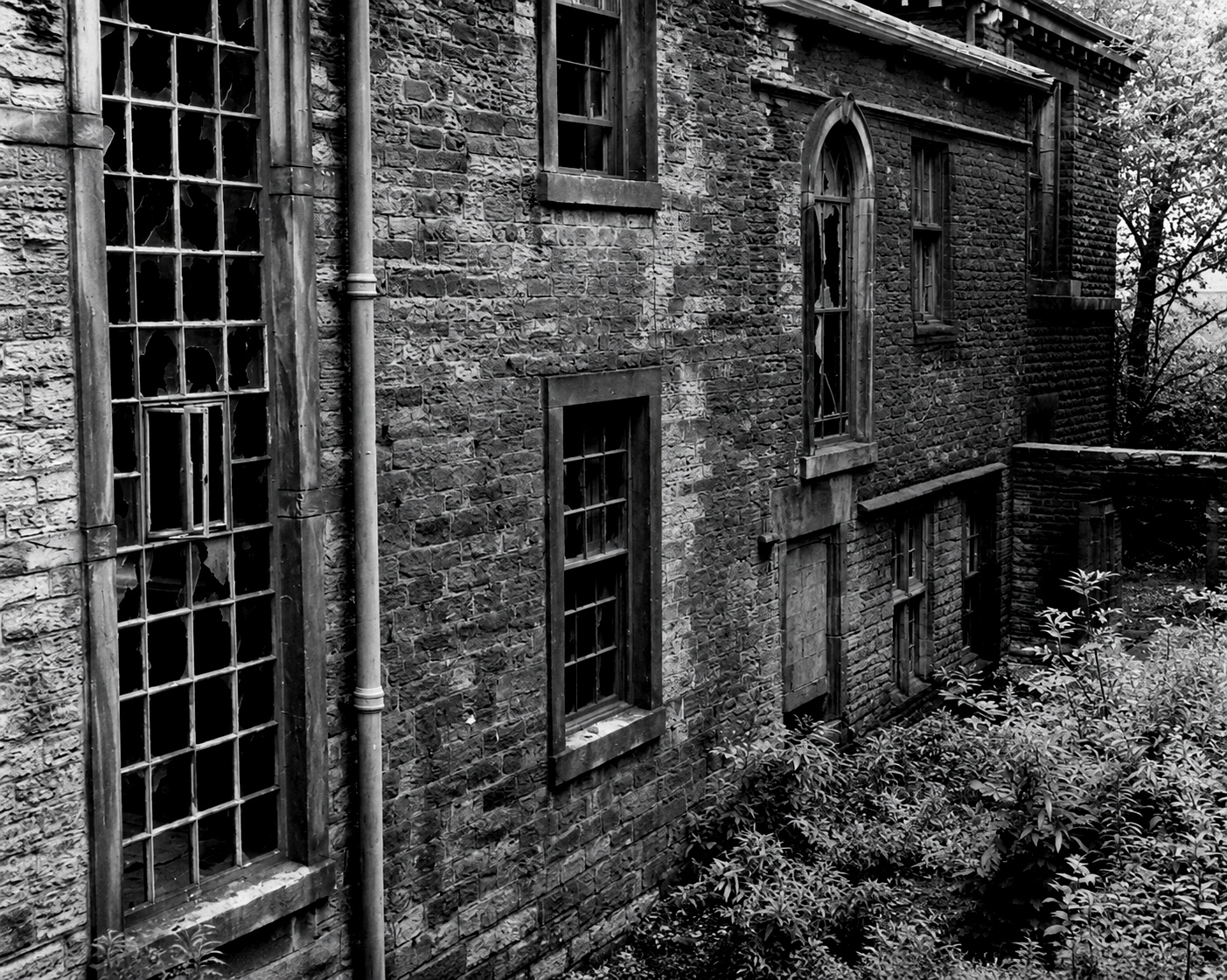
Like many manor houses of its period, it formed part of the rural landscape for generations.
Families lived there.
Children grew up there.
Land changed hands.
Fields were cultivated.
Seasons passed.
History unfolded quietly around it.
Above the entrance, however, one feature remained constant.
Three carved initials.
F.R.H.
Accompanied by the date 1699.
Visitors passed beneath them.
Residents scarcely noticed them.
Generation after generation, the inscription remained in place.
Yet no one could say with certainty who those initials represented.
As the centuries passed, the house itself gradually slipped from public memory.
In time, it became known simply as Green House.
Its original name faded from local use.
Then, in 1961, the building was demolished.
Its walls disappeared.
Its entrance was removed.
Its physical presence vanished from the landscape of Ossett.
It seemed that the story of Hassell Hall had come to an end.
It had not.
Because while buildings may disappear, documentary evidence often survives.
And sometimes, that evidence waits patiently for centuries until someone asks the right question.
Who Was F.R.H.?
The demolition of Hassell Hall did not bring its story to an end.
In many respects, it marked the beginning.
Some years later, a local newspaper in West Yorkshire posed a question that appeared deceptively simple.
"Who was F.R.H.?"
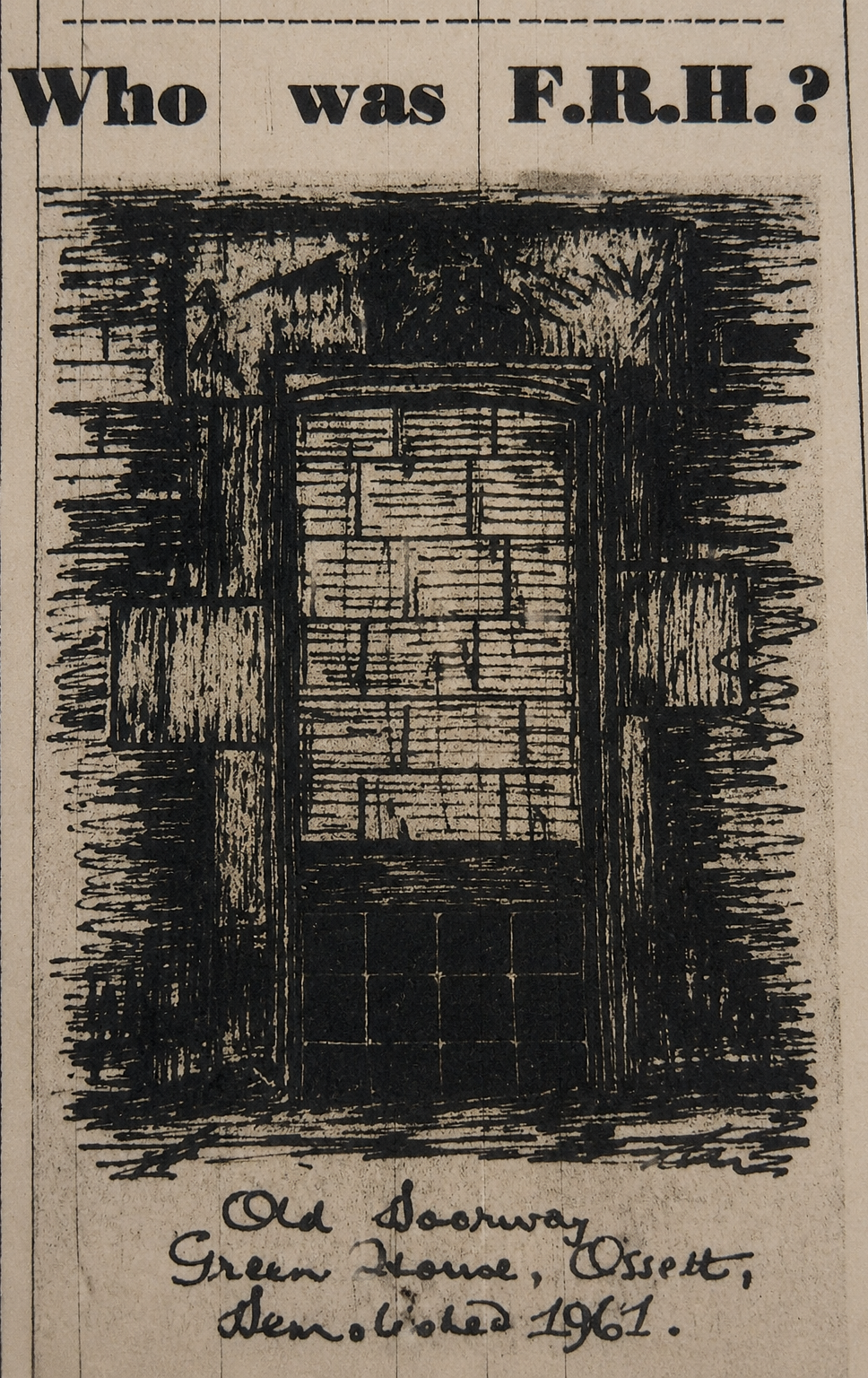
The question referred to the three initials that had once been carved above the entrance to the old manor house.
At first glance, it seemed little more than a curiosity.
A forgotten inscription.
An architectural detail whose meaning had vanished with the building itself.
Yet behind those three letters lay a much larger historical question.
Who had commissioned the house?
Who had lived there?
Why had their initials been carved so prominently above the entrance?
And how had their identities disappeared from local memory?
The enquiry was no longer about a building.
It had become an investigation into the history of a community.
For more than three centuries, the answer remained hidden within documents scattered across different archives.
Parish registers.
Property deeds.
Historical maps.
Probate records.
Newspapers.
Civil records.
Individually, each source revealed only a fragment of the story.
Collectively, they preserved something far more enduring than stone.
They preserved memory itself.
History rarely disappears. More often, it survives quietly within documents, waiting for someone prepared to read them together.
When Memory Found Its Voice
Every historical investigation begins with something missing.
Very few succeed in restoring the memory of a place.
The search for the identity behind the initials F.R.H. became a meticulous process of documentary comparison.
No single document provided the answer.
Instead, the evidence emerged gradually.
A name recorded in a parish register.
A property described in an early eighteenth-century deed.
References preserved in historical maps.
Entries within probate records.
Local newspapers.
Each source added another piece to the puzzle.
Taken separately, they appeared ordinary.
Together, they transformed the investigation.
The initials were no longer anonymous.
They belonged to real people.
F.R.H.
F — Foster
R — Richard
H — Hannah
For the first time in more than three centuries, the inscription above the entrance to Hassell Hall recovered its identity.
The stone no longer preserved only initials.
It preserved the memory of a family.
Restoring the Identity of Hassell Hall
Buildings do not always survive.
Fortunately, documents often do.
Although Hassell Hall disappeared from the landscape in 1961, its documentary record remained scattered across archives throughout West Yorkshire.
Each document preserved a different fragment of the story.
Together, they preserved the history of Hassell Hall.
None of these records had changed.
What changed was the way they were read.
By comparing documentary evidence from multiple sources, it became possible to reconstruct not only the history of a forgotten manor house, but also its place within the historical landscape of Ossett.
The investigation demonstrated that the building later known as Green House had originally been Hassell Hall.
Its original name had gradually disappeared from local use.
Its story had faded with it.
Documentary research restored both.
In doing so, it reconnected a lost manor house with the community to which it had once belonged.
More Than an Inscription
At first, the carved initials appeared to be little more than an architectural curiosity.
In reality, they became the starting point for reconstructing more than three centuries of local history.
Without them, the investigation might never have begun.
Without them, the surviving documentary evidence might never have been brought together.
The inscription became far more than a decorative feature.
It became the key that unlocked a forgotten historical narrative.
This is often how documentary research advances.
Not through dramatic discoveries.
But through careful observation.
Through patience.
Through comparison.
Through evidence.
Sometimes the smallest clue preserves the greatest story.
A Story Returns to the Community
Historical research achieves its greatest significance when it returns to the communities from which it originated.
More than three centuries after the initials were carved above the entrance to Hassell Hall, the story of the house once again became part of public memory.
Today, visitors to Green Park, close to the site where Hassell Hall once stood, can discover its story through a permanent heritage interpretation panel.
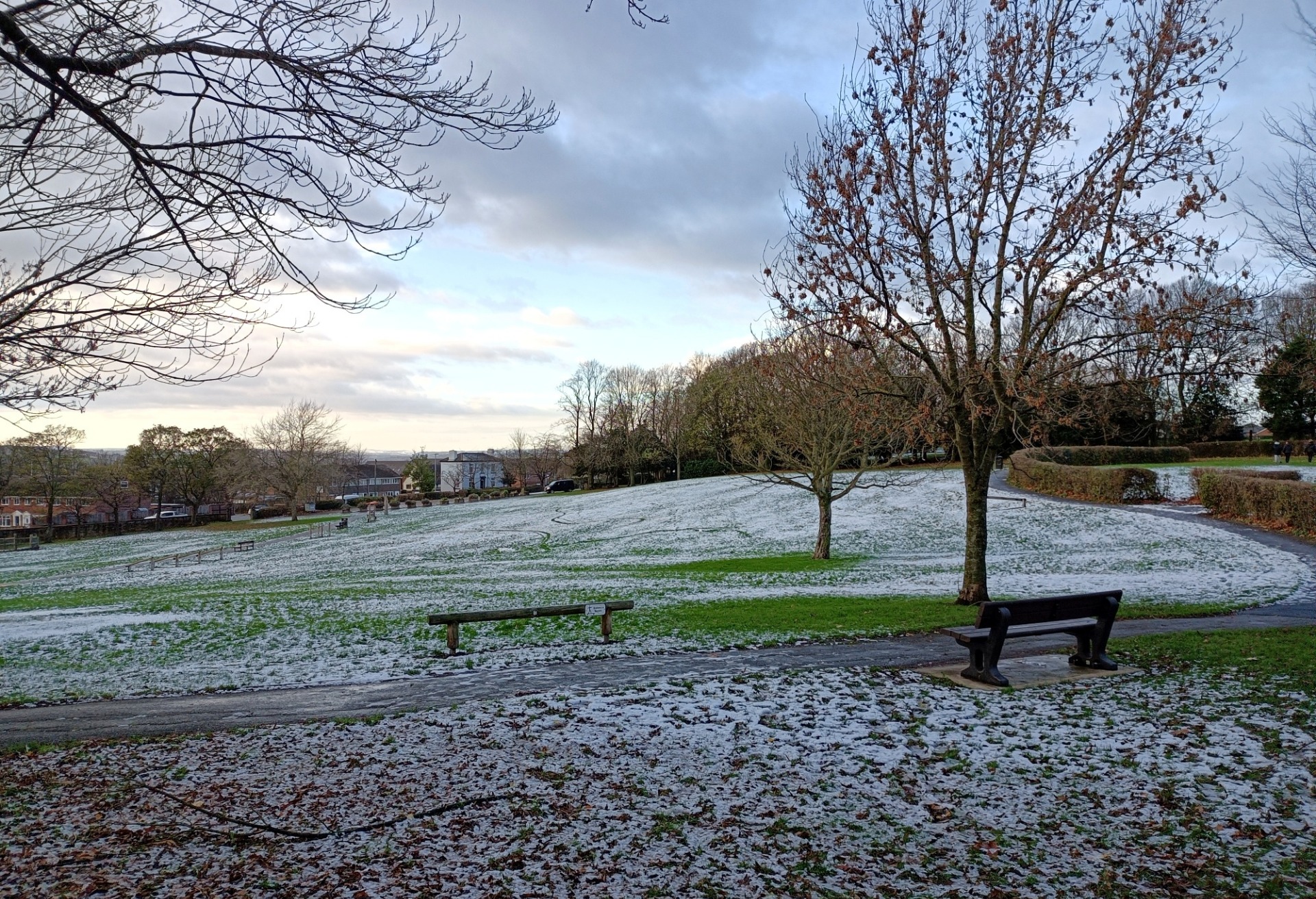
The building has gone.
Its story remains.
For the people of Ossett, the panel represents more than historical information.
It represents the restoration of a forgotten chapter in the town's documentary heritage.
The house no longer stands.
Its memory does.
And sometimes, that is the greatest achievement historical research can offer.
Across an Ocean
Historical documents rarely reveal how far they are capable of taking us.
One archive points towards another.
One forgotten record illuminates the next.
A single discovery raises questions that earlier generations never imagined asking.
That was precisely what happened during this investigation.
What had begun as an attempt to identify three carved initials above the entrance to a forgotten manor house in West Yorkshire gradually became something far larger.
The documentary evidence was no longer reconstructing the history of a single house.
It was revealing the beginning of a journey.
A journey that stretched far beyond Ossett.
Far beyond West Yorkshire.
Far beyond Britain itself.
One hundred and seventy-six years after the initials F.R.H. were carved above the entrance to Hassell Hall...
Separated by centuries.
United by archives.
The story of Hassell Hall had crossed an ocean.
When One Investigation Leads to Another
By this stage, the original question had been answered.
The initials had recovered their identity.
The history of Hassell Hall had been reconstructed.
The relationship between Richard Foster and Hannah Foster had been established through documentary evidence.
For many historical investigations, that would have marked the conclusion.
Instead, it marked a beginning.
As additional records were examined, the documentary trail continued.
Not into another Yorkshire parish.
Not into another county.
But into an entirely different continent.
What first appeared to be the history of one manor house gradually revealed itself to be part of a much broader historical narrative—one extending from West Yorkshire to South America.
The investigation had solved one mystery.
The archives quietly revealed the next.
From West Yorkshire to Argentina
The connection revealed itself gradually.
No single document explained it.
No single archive contained the complete story.
Only by comparing records preserved in England and Argentina did the wider historical picture begin to appear.
This investigation forms part of the international research project FOSTER History & Collective Memory, which brings together parish registers, property deeds, probate records, historical maps, official decrees, newspapers and other primary documentary sources preserved in both countries.
The purpose has never been simply to reconstruct a genealogy.
Its aim is to understand how documentary evidence can reconnect historical narratives that have remained separated for generations.
As the research expanded, one conclusion became increasingly difficult to ignore.
While West Yorkshire preserved one chapter of the story, another had quietly unfolded nearly seven thousand miles away.
The documentary evidence connected them.
Argentina, 1875
By the middle of the nineteenth century, the Republic of Argentina was undergoing one of the most significant periods of territorial organisation in its history.
Large areas of the country had yet to be systematically surveyed.
The geography of the Gran Chaco—its rivers, forests and vast plains—was still imperfectly understood.
For the Argentine government, obtaining reliable geographical knowledge had become a matter of national importance.
Scientific exploration was no longer simply an academic pursuit.
It had become an essential instrument of state-building.
Within this context, the Foster–Seelstrang Exploring Commission was established.
Its purpose was not merely to explore unknown territory.
It was to understand it.
To survey it accurately.
To map its rivers.
To identify its natural resources.
To evaluate land suitable for future settlement.
And to provide the Argentine State with reliable scientific information upon which future decisions could be based.
The Foster–Seelstrang Exploring Commission
In 1875, President Nicolas Avellaneda authorised the creation of the Commission through an official presidential decree.
The following decree marks the precise moment when Enrique Foster formally entered the documentary record of the Foster–Seelstrang Exploring Commission.
Among those appointed was the surveyor Enrique Foster, whose role within the Commission is documented in the official presidential decree establishing the expedition.
Working alongside Arthur von Seelstrang and Manuel Obligado, he participated in extensive surveying campaigns across northern Argentina.
Together, the Commission produced maps, technical reports and scientific observations that remain important historical sources for understanding the exploration and territorial development of north-eastern Argentina.
More than a century and a half later, those documents continue to be consulted by historians, geographers and researchers.
Like the archives of West Yorkshire, they have preserved far more than administrative information.
They have preserved memory.
A Documentary Bridge Between Two Nations
At first sight, there appears to be little connecting a seventeenth-century manor house in West Yorkshire with a scientific expedition undertaken in nineteenth-century Argentina.
Different centuries.
Different societies.
Different historical contexts.
Yet documentary evidence revealed an unexpected continuity.
One chapter began in 1699, above the entrance to Hassell Hall.
The other began 176 years later, within an official presidential decree issued in Buenos Aires.
Between those two documents lay an ocean.
Six generations.
Two continents.
Nearly two centuries.
Yet both formed part of the same documented historical journey.
Richard Foster belongs to the recorded history of Hassell Hall.
Enrique Foster belongs to the recorded history of the Foster–Seelstrang Exploring Commission.
One lived in West Yorkshire during the seventeenth century.
The other contributed to one of Argentina's earliest scientific surveying expeditions during the nineteenth.
For generations, these histories appeared entirely unrelated.
Yet the cumulative documentary evidence told a different story. By reconstructing a documented line of descent spanning six generations, this investigation demonstrated that Richard Foster of Hassell Hall and surveyor Enrique Foster belonged to successive chapters of the same documented family lineage—one beginning in seventeenth-century West Yorkshire and continuing 176 years later in the official records of the Foster–Seelstrang Exploring Commission in Argentina.
The documents did not create that connection. They simply made it visible once again.
History Revealed Through Evidence
Historical research is often imagined as the discovery of something entirely new.
In reality, it is more often the careful reconstruction of something that has gradually been forgotten.
The documents examined during this investigation had existed for generations.
Each archive preserved only part of the story. None preserved the whole.
What proved remarkable was not the existence of the documents themselves, but the ability to read them together.
Individually, each source preserved only a fragment of the story.
Collectively, they revealed a historical narrative that had remained hidden for more than three centuries.
Perhaps that is the greatest lesson offered by documentary research.
History is rarely preserved in a single place.
It survives in fragments—across archives, across communities and across generations.
Only when those fragments are brought together does the wider historical picture emerge.
History Never Travels Alone
History is often told through the lives of monarchs, politicians and military leaders.
Yet its foundations are just as often laid by people whose names rarely appear in textbooks.
Families.
Surveyors.
Craftsmen.
Teachers.
Merchants.
Farmers.
Men and women who crossed oceans carrying little more than knowledge, determination and hope.
Few imagined that their journeys would one day become part of history themselves.
When they left their homes, they carried far more than possessions.
They carried skills.
Traditions.
Languages.
Documents.
Memories.
Generation after generation, those journeys became woven into the history of communities far beyond their places of origin.
That is what happened with Hassell Hall.
And, nearly two centuries later, with the Foster–Seelstrang Exploring Commission.
Separated by geography.
Separated by time.
Connected through documentary evidence.
History rarely follows political borders.
It follows people.
Why This Story Matters
The significance of this investigation extends far beyond a single surname.
It is not necessary to bear the Foster surname to appreciate the value of documentary history.
Every community preserves forgotten stories.
Every town possesses places whose significance has gradually faded from memory.
Every archive contains fragments of the past waiting to be understood in new ways.
Each document represents only a fragment of the past.
Together, those fragments become history.
That is precisely what happened at Hassell Hall.
The investigation demonstrated that local history is never merely local.
Historical research does not create these connections.
It simply allows us to recognise them.
The Enduring Value of Documentary Research
Buildings may disappear.
Documents often survive.
That distinction lies at the heart of this investigation.
Hassell Hall no longer stands.
Its walls were demolished in 1961.
Its rooms have vanished.
Its architecture belongs to history.
Yet its documentary record endured.
Each document preserved something different.
Together, they preserved the history of a place that no longer exists.
Taken individually, each document appeared ordinary.
Together, they reconstructed an important chapter in the documented history of West Yorkshire.
This is why archives matter.
Why libraries matter.
Why local historical societies matter.
Without them, countless stories would disappear forever.
More Than a Family History
Although this investigation began with the history of one family, its conclusions reach much further.
It demonstrates how documentary research can restore forgotten places to public memory.
It illustrates how evidence preserved in different countries can contribute to a shared historical narrative.
Its greatest contribution, however, lies elsewhere.
Communities have always shaped one another.
Families migrate.
Ideas travel.
Knowledge crosses borders.
Documents allow those journeys to be remembered.
The story presented here is therefore not simply about the Foster family.
It is about the relationship between documentary evidence and collective memory.
It is about understanding how records preserved across centuries can reveal a single historical journey.
Beyond Time
Buildings disappear.
Landscapes change.
Generations pass.
Yet documentary evidence possesses a remarkable ability to outlive them all.
Hassell Hall has vanished.
The Foster–Seelstrang Exploring Commission completed its work more than a century ago.
Yet both continue to exist—not in stone, but in documents.
That is why this story can still be told.
The Responsibility of Remembering
Every generation inherits more than buildings.
It inherits memory.
Some memories survive naturally.
Others survive only because someone chooses to preserve them.
That is the purpose of historical research.
Not to rewrite the past.
Not to romanticise it.
But to understand it.
To ask questions.
To compare evidence.
To reconnect forgotten names with forgotten places.
And, occasionally, to discover that history has preserved connections that time allowed us to forget.
Perhaps that is the enduring lesson of Hassell Hall.
History does not disappear when a building is demolished.
It disappears only when nobody remains willing to remember it.
A Letter Across Three Centuries
As this investigation comes to a close, one historical voice deserves to be heard once more.
In 1731, the Reverend Thomas Dickenson wrote these words about his father-in-law, Richard Foster:
"Children and grandchildren should regard it as a great blessing to be descended from those who feared God, lived with purpose, set a good example, and faithfully prayed for those who would come after them."
Dickenson could scarcely have imagined that, nearly three centuries later, documentary evidence preserved in England and Argentina would make it possible to reconstruct part of that family story across six generations.
His words were never intended as a historical prediction.
Yet they now stand as a enduring reminder that the greatest legacies are not measured only by what people build, but by the lives they shape, the example they leave behind, and the memory that future generations choose to preserve.
Every archive preserves more than documents. It preserves the possibility that forgotten history may one day be remembered again.

Ezequiel Foster
Founder and Director
FOSTER History & Collective Memory
Acknowledgements
This investigation would not have been possible without the long-term preservation of documentary heritage by archives, libraries, historical societies and public institutions in both England and Argentina.
The author wishes to acknowledge the invaluable work of archivists, librarians, local historians and researchers whose commitment to preserving original records continues to make historical research of this kind possible.
Their work ensures that the documentary memory of communities remains available not only to the present generation, but also to those yet to come.
Research Project
FOSTER History & Collective Memory
FOSTER History & Collective Memory is an international historical research initiative dedicated to reconstructing the documented history of people, families and places through the comparative study of primary sources preserved in different countries.
The project integrates parish registers, property deeds, probate records, historical maps, newspapers, government records, photographs and archival collections to recover historical narratives that have become fragmented or forgotten over time.
By reconnecting documentary evidence preserved across national boundaries, the project seeks to contribute not only to family history, but also to a broader understanding of the shared heritage linking communities across generations and continents.
Editorial Note
This article is based upon original documentary evidence preserved in archives and historical collections in England and Argentina.
Every historical interpretation presented here has been developed through the comparative analysis of parish registers, deeds, probate records, historical maps, official decrees, newspapers and other primary documentary sources.
The investigation forms part of the ongoing international research project FOSTER History & Collective Memory.
Selected References
England
- Foster, Joseph. Familiae Minorum Gentium: Genealogical Memoirs of Many Families of the United Kingdom. Vol. I. London.
- Heywood, Oliver; Dickenson, Thomas; Turner, J. Horsfall (eds.). The Nonconformist Register of Baptisms, Marriages and Deaths (1644–1752). London.
- Horbury Parish Register. West Yorkshire Archive Service, Wakefield, England.
- Leeds Intelligencer. 20 June 1775.
- Memorials of Deeds (1704–1970). West Yorkshire History Centre, Wakefield, England.
- Ossett: Deeds and Documents. Yorkshire Archaeological and Historical Society.
- The Ossett Observer. Various historical issues.
- Wakefield Manor Book (1709). Yorkshire Archaeological Society Record Series, Vol. 101.
- Williams, Rev. J. G. Two Centuries of Worship and Work: A Short History of the Congregational Church, The Green, Ossett, 1717–1917. Ossett, 1917.
Argentina
- Academia Nacional de la Historia. Buenos Aires, Argentina.
- Archivo General de la Nación (AGN). Buenos Aires, Argentina.
- Archivo Histórico de la Provincia de Santa Fe. Santa Fe, Argentina.
- Báez, Carlos Alberto. Orígenes de la Agrimensura en el Chaco y Norte de Santa Fe. Revista Prever, 1988.
- Fontana, Luis Jorge. El Gran Chaco.
- Honorable Congreso de la Nación Argentina. Law No. 686. Buenos Aires, 1874.
- Presidential Decree appointing Surveyor Enrique Foster to the Foster–Seelstrang Exploring Commission. Buenos Aires, 1875.
- Seelstrang, Arturo. Informe de la Comisión Exploradora del Chaco. Buenos Aires, 1878. 2nd ed. Buenos Aires: Eudeba, 1977.
Unpublished Primary Sources
Recommended Citation
- Dickenson, Thomas. Private family letter concerning Richard Foster and his descendants. Manuscript, 1731. Preserved in the private Foster family archive and transmitted through successive generations.
- Private Foster Family Archive. Unpublished family correspondence, genealogical records and documentary material preserved through successive generations.
Foster, Ezequiel. The Lost Story of Hassell Hall: How Three Forgotten Initials in a West Yorkshire Manor House Revealed an Extraordinary Historical Connection with Argentina. Buenos Aires: FOSTER History & Collective Memory, 2026.
Illustration Credits
Historic photographs, maps, documentary reproductions and other illustrative material are reproduced with the kind permission or acknowledgement of the respective archives, libraries, historical societies and institutions credited throughout this investigation.